
Blank Label Stickers (FAQ)
JOY PAPER's blank label stickers are designed for e-commerce shipping, product barcodes, warehouse management, and everyday printing needs. A variety of materials, sizes, and supply formats are available, allowing suitable specifications to be selected according to different label printers, barcode printers, and printing methods to meet on-demand printing and high-volume usage requirements.
Thermal paper, coated paper, and colored labels are available for applications such as logistics shipping labels, product barcodes, product specifications, inventory classification, and asset identification. Stable materials and processing quality help ensure clear printing and smooth feeding, improving the efficiency of daily printing and labeling operations.
What is the difference between thermal paper and coated paper labels?
Thermal paper prints through heat and does not require a ribbon, making it suitable for logistics, retail, and short- to medium-term information labeling. Coated paper generally uses a ribbon for thermal transfer printing, and the durability of the printed information and its range of applications can be adjusted according to the ribbon type. Storage duration, friction, temperature, humidity, and equipment should all be considered when choosing.
What are 100 × 150 mm (4 × 6 in.) labels suitable for?
This size is commonly used for e-commerce shipping labels, convenience store shipping, and logistics labels. JOY PAPER can supply roll or fanfold formats. Before ordering, please confirm the platform layout, printer width, sensing method, and available loading space.
How should I choose between roll labels and fanfold labels?
Roll labels are convenient for equipment with roll holders and are suitable for general continuous printing. Fanfold labels can be fed from outside the printer and are commonly used for high-volume logistics printing. The choice should be based on the equipment's feeding method, available desk space, printing volume, and replacement frequency.
How can I confirm whether blank labels are compatible with my label printer?
Please provide the brand and model, and confirm the maximum print width, label size, core inner diameter, roll outer diameter, winding direction, single-row or multi-row format, and sensing method such as gap, black mark, or continuous media. Confirming only the label length and width may still result in the roll not fitting or the printer being unable to position the labels correctly.
Can blank labels be used to print barcodes and QR Codes?
Yes, but scanning quality is affected by printhead resolution, printing speed, darkness, face material, ribbon compatibility, and barcode size. Before large-scale use, we recommend testing printing and scanning with the actual printer, scanner, and system.
Are thermal labels waterproof, oil-resistant, and scratch-resistant?
Standard thermal paper has limited resistance to water, oil, and scratches. If higher resistance is required, three-proof thermal paper, synthetic materials, or other special constructions can be considered. The level of resistance of so-called three-proof materials can still vary, so testing should be conducted based on contact duration, liquid type, and usage environment rather than assuming complete resistance.
How should blank thermal labels be stored?
They should be stored in a cool, dry place and kept away from high temperatures, direct sunlight, humidity, friction, and prolonged contact with alcohol, solvents, oils, or materials containing plasticizers. If the printed information needs to be retained for a long period, thermal transfer labels or other more durable materials should be evaluated first.
- Related Products
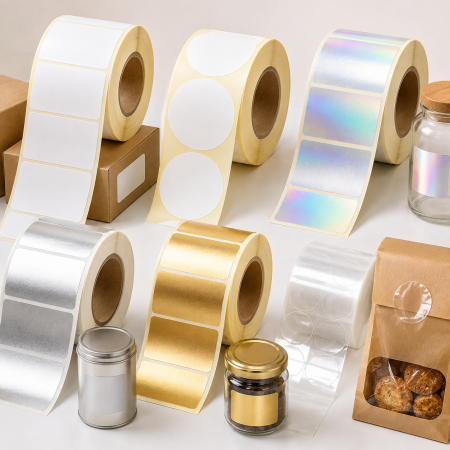
Blank Label Stickers | Thermal Paper, Coated Paper, Woodfree Paper, Colored Labels & 4 × 6-Inch Convenience Store Shipping Labels
Blank Label Stickers | Thermal Paper, Coated Paper & 4 × 6-Inch Shipping Labels Blank label...
Details